Custom Wool Replicas for Exotic, Niche, and Farm Pets
The bond we share with our pets is rarely defined by how much fur they have or whether they fit comfortably on a standard sofa. For many, a "pet" is a Bearded Dragon that sits on a shoulder during morning coffee, a pair of rats that learn complex tricks, or a miniature goat that manages the backyard with more personality than a dozen dogs.
When it comes time to memorialize these unique companions or celebrate them with a custom sculpture, the challenge changes. Most traditional pet portraiture is designed for the soft fluff of a Golden Retriever or the sleek coat of a tabby. Recreating a reptile’s scales, a hamster’s tiny paws, or a pig’s coarse bristles requires a different technical vocabulary. At Raylume, we’ve expanded the art of needle felting beyond traditional mammals to capture the specific, often overlooked details of exotic and farm pets.
## Beyond Fur: The Art of Felted Reptiles and Exotics
Replicating a reptile in wool presents a fascinating artistic paradox: how do you use a "warm," soft medium to represent a "cold-blooded," armored creature? Standard needle felting usually relies on the natural loft of wool to create volume. For a lizard or snake, we pivot to a technique called sculptural wool layering. Instead of building a soft surface, the wool is felted to an extremely high density until it becomes firm and structural. This allows the artist to "carve" with the needle, defining skin folds, dewlaps, and the distinct ridge of a spine.
How are needle felting techniques adapted for reptilian textures and anatomical accuracy in lizard replicas? To achieve a realistic lizard skin texture, artisans move away from loose fibers and instead use high-density sculptural layering, where wool is felted into a firm, almost clay-like state to allow for the manual "etching" of scales and skin folds. This process is often combined with the application of specific silk or plant-based fibers that have a natural sheen, mimicking the iridescent or reflective quality of reptilian scales that standard matte wool cannot provide on its own. By focusing on the structural anatomy—such as the precise articulation of the toes and the swell of the jowls—the artist can create a replica that feels anatomically "correct" despite being made of soft materials.
When commissioning a piece like a Gecko or a Chameleon, we focus on these transitions of light and shadow. A Crested Gecko’s "eyelashes" or a Bearded Dragon’s throat spikes are delicate features that require steady-hand detail work with a single-gauge needle, ensuring the finished piece captures the alert, ancient energy of these animals.
## Small Wonders: Realistic Miniatures for Rodents and Niche Mammals
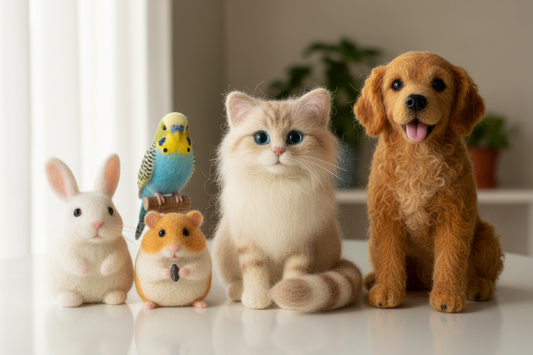
For owners of hamsters, rats, and gerbils, the appeal of a needle-felted replica often lies in the 1:1 scale. There is something profoundly moving about holding a sculpture that is the exact size and weight of a pet that has passed. However, "small" does not mean "simple." In fact, the smaller the animal, the more critical the proportions become.
At Raylume, we define **1:1 Scale Realism** in small rodent memorials as the practice of matching the exact physical dimensions and "personality markers" of the individual pet, specifically focusing on the anatomical nuances of the hands, ears, and facial symmetry. This standard requires the artist to look past the general "rodent" shape to capture the specific twitch of a rat's nose, the translucent quality of a hamster’s ears, or the way a gerbil’s tail tuft sits at rest.
Capturing a Syrian hamster’s "pudgy" silhouette or the inquisitive, bright-eyed expression of a pet rat requires more than just matching fur color. It requires an understanding of their skeletal structure. We use internal wire armatures for these miniatures, allowing the legs and tails to be posed in a way that reflects how your pet actually stood or sat.
## Farm-to-Felt: Commemorating Goats, Pigs, and Livestock
Farm animals offer some of the most interesting textural challenges in the fiber arts. Unlike the soft, uniform coat of a house cat, a goat or a pig often has a multi-tonal, multi-textured coat. A miniature pig might have sparse, coarse bristles over skin that shows through in "mud-dusted" patterns, while a Pygmy goat might have a soft undercoat protected by long, wiry guard hairs.
To replicate these textures, we utilize specialized livestock fiber blends. Replicating the coarse, weather-resistant hair of a goat or the stiff bristles of a pig is impossible with standard Merino wool, which is too soft and fine. Instead, we blend coarser fibers like Mohair (for shine and length), Karakul (for durability and "wiriness"), and even raw, uncombed wool to mimic the natural, pasture-accurate texture of livestock. This blending process allows us to create "guard hairs" that stand away from the body, giving the miniature the rugged, structural integrity characteristic of hooved animals.
Whether it’s the specific shape of a pig’s snout or the rectangular pupils of a goat, these details are what transform a generic animal figure into a true portrait of a beloved farm companion.
## The Niche Commission Guide: Capturing Your Unique Pet
Commissioning a replica for a non-traditional pet requires a different approach to reference photography. Because these animals have anatomies that vary wildly from cats and dogs, the artist needs to see the "architecture" of the animal from angles that aren't usually captured in candid snapshots.
When you prepare a commission for Raylume, we look for details that define your pet’s unique identity. For a reptile, the pattern on the top of the head is as distinct as a fingerprint. For a rodent, the way the fur transitions around the belly and paws is essential for a realistic 1:1 replica.
### The Raylume Reference Photo Checklist for Niche Species
To ensure the highest level of accuracy for your custom commission, please provide photos following this specific checklist:
* **For Reptiles:**
* **The "Top-Down" Survey:** A clear shot from directly above to map the scale patterns and symmetry of the spine.
* **Side-Profile Headshot:** To capture the exact shape of the snout, jawline, and the placement of the ear holes or crests.
* **Eye Detail:** High-resolution close-ups of the iris; reptile eyes are often incredibly complex in color.
* **For Small Rodents:**
* **Eye-Level Frontal:** Photos taken at the pet's height to capture the facial proportions and the "width" of the cheeks.
* **The "Hands and Feet":** Shots of the underside or paws, as the color of the paw pads and the length of the nails are key personality markers.
* **Full Tail View:** Especially for rats and gerbils, to see the color gradient and any unique markings.
* **For Farm Animals:**
* **Texture Close-up:** A photo taken close enough to see the "grain" of the hair; this helps us choose the right fiber blend.
* **The "Hoof-to-Ground" View:** To understand the leg structure and how the animal carries its weight.
* **Marking Map:** Clear shots of the "other side" of the animal—farm animals often have asymmetrical patches and spots that are easily missed.
Every pet, whether they live in a terrarium, a hutch, or a pasture, leaves a mark on our lives. Our goal at Raylume is to ensure that the craftsmanship of your replica matches the depth of that connection, regardless of the species.
Previous
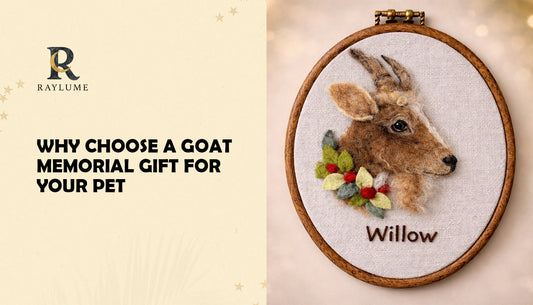
Why Choose a Goat Memorial Gift for Your Pet
Next
Finding a realistic pet replica without the weirdness